When is it NOT worth using AI in a system?
Simple rules, exact calculations, searches and automations don't need AI. See when it only adds cost and unpredictability — and when it really helps.
Artificial intelligence is showing up more and more in the systems companies use. It’s already possible to build assistants that answer questions, analyse documents, interpret messages and even carry out tasks.
That opens up a lot of possibilities. But there’s a problem with all this popularity: not every problem needs artificial intelligence.
In some cases, using AI makes a system more expensive, more complex and even less predictable than a traditional solution. Before asking “how do I put AI in my system?”, it may be better to ask:
“Do I really need AI to solve this problem?”
If a simple rule solves it, you may not need AI
Imagine a company has the following rule:
Orders over $1,000 need approval.
You don’t need artificial intelligence for that. A traditional rule checks the amount and decides:
if amount > $1,000 → request approval
The result is predictable, fast and easy to test. Using AI here would add complexity with no real benefit.
The principle applies to many situations: if the problem can be solved with a clear rule, a software rule is probably enough.
1. When the process is completely predictable
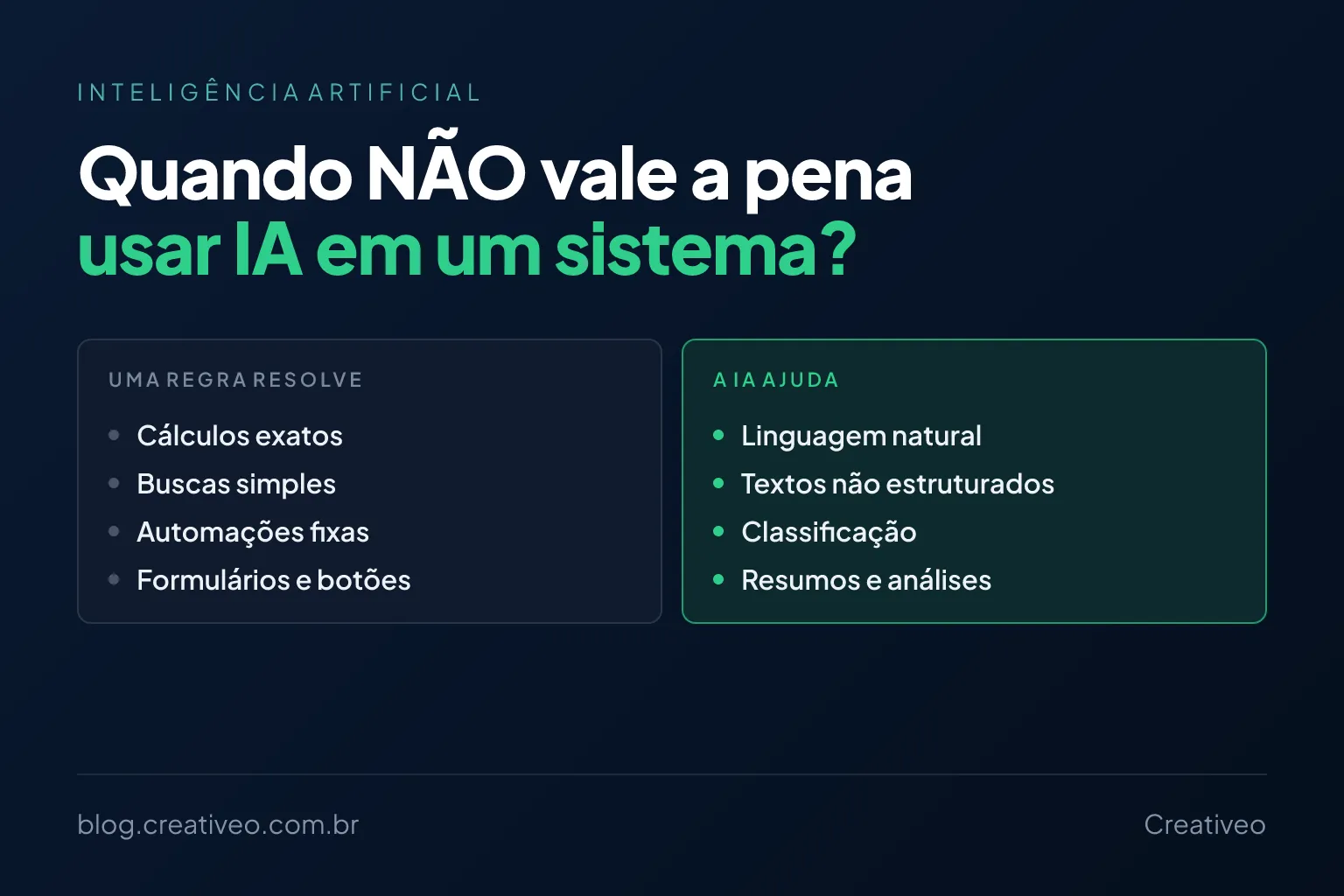
Computers are excellent at carrying out well-defined instructions: calculating prices, applying discounts, checking limits, validating fields, changing statuses, generating numbers, calculating taxes, checking dates, sending notifications and blocking access.
Picture a system that needs to check whether a customer falls within a certain age range. If the rule is known, just code it. There’s no advantage in asking an AI to figure out something the system already knows exactly how to calculate.
2. When you need 100% accuracy
AI models work with probabilities. That’s what makes the technology powerful for interpreting language, images and other complex data — but it also means some answers may not be entirely predictable.
When an error is unacceptable, deterministic rules are usually a better fit. For example:
“The system must calculate the exact instalment amount.”
A mathematical formula is far more appropriate than asking an AI to calculate the value. AI can even help the user understand the result, but the calculation remains the system’s responsibility.
3. When the amount of data is small
AI tends to make more sense when there’s a significant amount of information to analyse, or when the data is hard to interpret with traditional rules.
Now picture a company with a table of 100 customers, with name, phone, city and status. If the need is to find customers in a given city, a database query solves it. There’s no reason to send that data to an AI model: a traditional search is simpler, cheaper and more predictable.
4. When a traditional search already does the job
Imagine the user types:
“Customers in Boston”
If the system has a well-structured city field, a simple query is enough.
Now imagine the user asks:
“Which customers bought more than once in the last six months and haven’t placed any order this month?”
In this second case, a natural-language layer might make the experience more useful. The difference is in the problem.
AI shouldn’t replace a simple search just because it can.
5. When AI adds cost without a return
Using AI in a system usually comes with a cost. Depending on the solution, billing can be tied to the number of requests, the volume of data processed, the model used, storage, processing and infrastructure. If AI isn’t delivering a matching benefit, that cost doesn’t make sense.
Picture a company that wants to use AI to automatically answer:
“What are your opening hours?”
If that information is fixed, a stored answer in the system solves it far more simply. It makes no sense to turn static information into an AI operation just to say the system uses artificial intelligence.
6. When the answer has to be fully predictable
Picture a system that needs to say:
“Your next charge will be on the 10th.”
If the date is in the database, the system should simply look it up. There’s no need to ask an AI to work out the answer.
An interesting alternative is to use AI only to turn the system’s information into a more natural reply:
“Your next charge is scheduled for the 10th.”
AI improves the interaction, but the information still comes from the system. That separation matters.
7. When a traditional interface is faster
Chatting with an AI isn’t always the most efficient way to get a task done.
In a sales system, if the salesperson needs to record product, quantity, price and customer, a form is much faster. It wouldn’t make sense to make them type:
“Add three units of product X for customer John at $50 each.”
when four fields get the job done in a few seconds.
AI is useful when the user needs to explain something in free form. When the information is already structured, a traditional interface is usually better.
8. When the problem is the process, not the technology
Sometimes a company believes it needs AI because its process is disorganised. But putting AI on top of a bad process doesn’t necessarily fix the problem.
Picture a company with information scattered across spreadsheets, emails, WhatsApp, different systems and documents. Before building an assistant to answer questions about all that, it may be necessary to organise the data and integrate the systems — otherwise, the AI will struggle to find reliable information. Often the first step is to replace the spreadsheets with a system.
Organise the process first. Then assess where AI can help.
9. When a traditional automation is enough
Imagine that every day at 6 p.m. a company needs to send out a report. The process is always the same:
- fetch the data;
- generate the report;
- send it by email.
That’s an automation. You don’t need AI to decide what to do: the system runs these steps on its own every day.
Now imagine the report has to be analysed and summarised, highlighting anything out of the ordinary. That’s where AI starts adding value.
Automation executes rules; AI helps when interpretation or analysis is involved. To figure out which case is yours, see how to turn a manual process into an automated system.
10. When the user doesn’t need a conversation
The popularity of AI assistants has made the chat interface look right for almost everything. It isn’t always.
In a parking app, the user wants to pay $20. A button is enough — there’s no need to open a chat and explain what they want to do.
Traditional interfaces are still excellent for objective, repetitive tasks. AI can complement an interface, but it doesn’t have to replace everything.
So when does AI really make sense?
AI tends to pay off when there’s information that’s hard to handle with traditional rules.
Natural language
The user can ask the same question in different ways:
“How much did I sell last month?”
“How were my sales the previous month?”
“Show last month’s revenue.”
An AI interprets these variations and turns them into an intent the system understands.
Unstructured text
Documents, messages and text can contain information that isn’t organised into fields. AI helps interpret that content.
Classification
A company may receive thousands of messages and need to sort them by topic.
Summaries
Long reports and documents can become summaries that are easier to consult.
Assistants
The user explains what they want in natural language, and the system interprets the intent and runs the available functions.
In these cases, AI solves a problem that would be much harder to handle with fixed rules alone.
AI doesn’t need to control the whole system
Adding AI doesn’t mean handing control of the system to a model. A safer architecture separates responsibilities:
User → AI → system function → API → database
The user asks:
“Which orders are awaiting payment?”
The AI interprets the question and calls a specific system function. The system looks up the orders. Then the AI organises the result and presents it naturally.
In this model, the AI doesn’t need unrestricted access to the database. It interprets; the system validates and executes. The full architecture is in how to add an AI assistant to your system.
What if the AI gets it wrong?
That’s another reason not to put AI in every part of the system. When a wrong answer could cause a serious problem, you need to think carefully about where AI will be used.
A sensible approach is to leave critical rules to traditional software:
- AI: interprets “I want to cancel my order”;
- System: checks whether the order can be cancelled;
- System: carries out the cancellation.
AI helps understand the request, but it doesn’t decide on its own whether the operation is allowed.
Before using AI, ask these questions
- Is there a simple rule that solves the problem?
- Is the information already structured?
- Do I need a 100% predictable answer?
- Would a traditional interface be faster?
- Does AI really save time or money?
- Is the cost of AI justified by the benefit?
- What happens if the AI misinterprets something?
- Can I start with a small feature?
If the answers show that a traditional solution already handles the problem well, there’s probably no need for AI. If the problem involves natural language, interpretation, classification, analysis or unstructured content, AI may make more sense.
The best technology is the one that solves the problem
There’s a temptation to put artificial intelligence into every new product. But technology shouldn’t be used just because it’s trending.
A good solution combines different approaches — traditional rules, automations, integrations, databases, conventional interfaces and artificial intelligence — and each tool handles what it does best.
AI doesn’t have to replace the system. It can be just one part of it. And, in many cases, the best decision is precisely not to use it.
Thinking about adding AI to your system?
Before choosing a model or a tool, it’s worth understanding which problem you want to solve. Maybe you need artificial intelligence. Maybe a simple integration solves it. Maybe a traditional automation is enough. And maybe a small change to the process itself makes the problem go away.
Get in touch through the form and tell us what you need to solve.
The goal isn’t to put AI in the system. It’s to use the right technology to make the business more efficient.
A few other articles you may find useful:
- How to add an AI assistant to your system — when AI does make sense, how to integrate it safely.
- How to turn a manual process into an automated system — traditional automation first, AI where there’s interpretation.
- 7 signs it’s time to replace spreadsheets with a system — organising the data before thinking about AI.
- How does custom software development work, start to finish? — understanding the problem before choosing the technology.
- Does SEO still matter now that people search with AI? — the other side of AI: what changed in how people search.