Custom software or off-the-shelf: which should you choose?
When an off-the-shelf tool is enough, when custom software pays off — and why the right answer is often to automate just one part of the process.
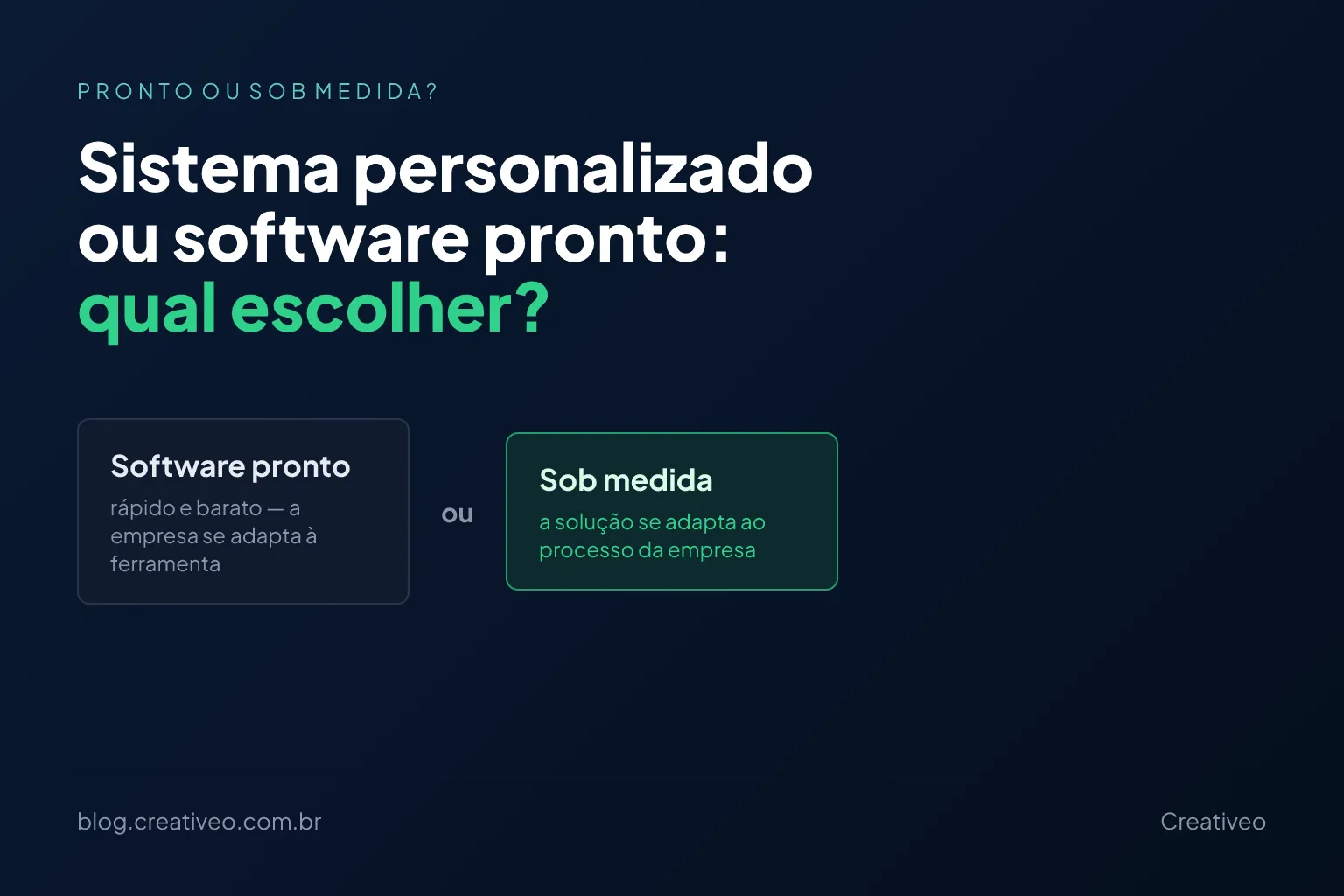
When a company realises it’s losing time to spreadsheets, manual tasks, scattered information or processes that are hard to keep under control, one of the first questions is usually: should we build custom software or use something that already exists on the market?
There’s no single answer. Off-the-shelf software solves the problem quickly and with a smaller investment; custom software makes sense when the process is specific or when the tool’s limitations start getting in the way. The choice depends far more on the problem you need to solve than on the technology.
What is off-the-shelf software?
It’s a product built to serve many companies with similar needs: finance systems, management platforms, CRMs, invoicing, scheduling, inventory control, customer support, project management.
The big advantage is that it already exists. Instead of waiting months for a project, the company subscribes, configures it and starts using it — usually with a lower upfront cost.
But there’s an important catch: the company adapts to the way the tool works. It may have exactly the feature you need, or you may run into its limits.
What is custom software?
It’s a system built for a specific company process. The path runs the other way: first you understand the problem and the process; then you build the solution.
Picture a company that receives orders through several channels, looks up information in other systems and then updates several records by hand. Off-the-shelf software solves part of that. Custom software can connect the tools, centralise the orders and automate the repetitive steps.
The goal isn’t “to have a system”. It’s to solve a specific business problem.
When off-the-shelf software usually makes sense
When the process is common and good products already exist. If all you need is to manage customers, issue invoices, organise tasks, track bills, manage inventory, book appointments or follow sales, look around before building anything. It saves time and money.
Established products also come with things a custom project would have to build from scratch: users, permissions, reports, backups and integrations.
When off-the-shelf stops being enough
The trouble starts when the company depends on workarounds, spreadsheets and side processes to make the tool work:
The system tracks orders, but it’s missing an important integration.
So someone exports the data to a spreadsheet. Someone else copies it into another system. At the end of the day, somebody checks it all by hand.
The software seemingly solved the problem — but created a new process around itself. If that sounds familiar, take a look at the signs it’s time to replace spreadsheets with a system.
When custom software can be worth it
1. Your process is very specific
If the operation relies on its own rules, unusual workflows or information that other businesses don’t handle, finding a suitable off-the-shelf product is hard.
2. You need to connect several systems
Maybe the company already uses several tools that don’t talk to each other. You don’t always need to replace them: a system or an automation can act as a bridge between them.
3. Manual work is eating up time
If staff copy information, check data or repeat tasks that follow well-defined rules, there’s an automation opportunity — and you can map that process before choosing any technology.
4. The software’s limits are hurting the business
Sometimes it’s not just a missing feature. The system needs to fit the company’s process, not the other way around.
5. Software is part of what you sell
Using software internally is different from having software as part of your product. A company offering a platform to its own customers may need its own solution from day one.
There’s a third option
The decision doesn’t have to be off-the-shelf vs. custom. There’s a very useful alternative: start small.
A company uses sales software, but has to copy the orders every day into a spreadsheet used by the finance team.
Instead of replacing the whole product, an integration moves that information automatically. The problem is solved without building a system from scratch — the kind of solution that often makes a lot of sense for small businesses.
How to decide?
A few questions help you get started:
| Question | If the answer is “yes” |
|---|---|
| Is there an off-the-shelf product that solves the problem? | Start by evaluating it |
| Is the process common across many companies? | Off-the-shelf may make sense |
| Does your process have very specific rules? | Consider a custom solution |
| Do you need to connect several systems? | Look at an integration or automation |
| Does the team rely on spreadsheets to fill the tool’s gaps? | Find out why that happens |
| Is the current software limiting the company’s growth? | Evaluate alternatives |
| Will the system be part of the product you sell? | Your own solution may be necessary |
But the most important question is a different one: how much is this problem costing the company today?
If a tool costs R$ 200 a month and fully solves the problem, building something of your own probably doesn’t make sense. If staff spend dozens of hours a month working around its limits, the maths changes. The cost isn’t just the price of the software — it’s also the process. To compare both sides, see how much custom software costs for your business.
Building a system doesn’t mean building something huge
A common mistake is assuming custom software means a large platform with dozens of features. It doesn’t have to. You can start with a single screen, a registration form, an integration, a dashboard, an automation, a small app or an API.
As the business sees value, new features come in. That approach lowers the initial investment and lets you validate the solution before turning it into something bigger.
What about artificial intelligence?
AI has shifted this discussion a little. Modern development tools make it possible to build prototypes, features and automations faster than a few years ago.
That doesn’t mean every custom system is now cheap, or that AI replaces the work of understanding the business. It means some solutions that used to require a much larger project can now be built more leanly — including an AI assistant inside your own system.
So it’s worth looking at the problem before assuming “custom software is too expensive”. Sometimes you don’t need a full platform, just a small solution that removes one bottleneck.
So, which one should you choose?
Choose off-the-shelf software when it already solves your problem well.
Consider a custom solution when the process is specific, needs integrations, or the limits of existing tools are hurting the operation.
And before choosing either, consider the third possibility: maybe you only need to automate one part of the process.
The goal isn’t to own software because it feels more modern, nor to bend the whole company around a tool just because it exists. It’s to find the solution that solves the problem at a cost and complexity that make sense.
Need help deciding?
You don’t need to arrive with a fully defined project. Tell us how the process works today, which tasks are manual and where the main problems are, and we’ll assess whether it makes more sense to use off-the-shelf software, build an automation, connect existing tools or develop a custom solution.
Get in touch through the form and describe the process that bothers you most.
Sometimes the best solution isn’t building a whole system. It’s building exactly what’s missing.
A few other articles you may find useful:
- How much custom software costs for your business — investment ranges, from a small automation to a complete system.
- How to turn a manual process into an automated system — how to map the process before choosing a solution.
- 7 signs it’s time to replace spreadsheets with a system — when side spreadsheets show the tool isn’t keeping up.
- How long does it take to build custom software? — if you decide to build, how long to expect.
- How do you know if your business needs an app? — the same reasoning applied to website vs. app.